The Hospital Gymnasium in the 1930s: A Room with an Argument in It
The Space That Defined the Claim
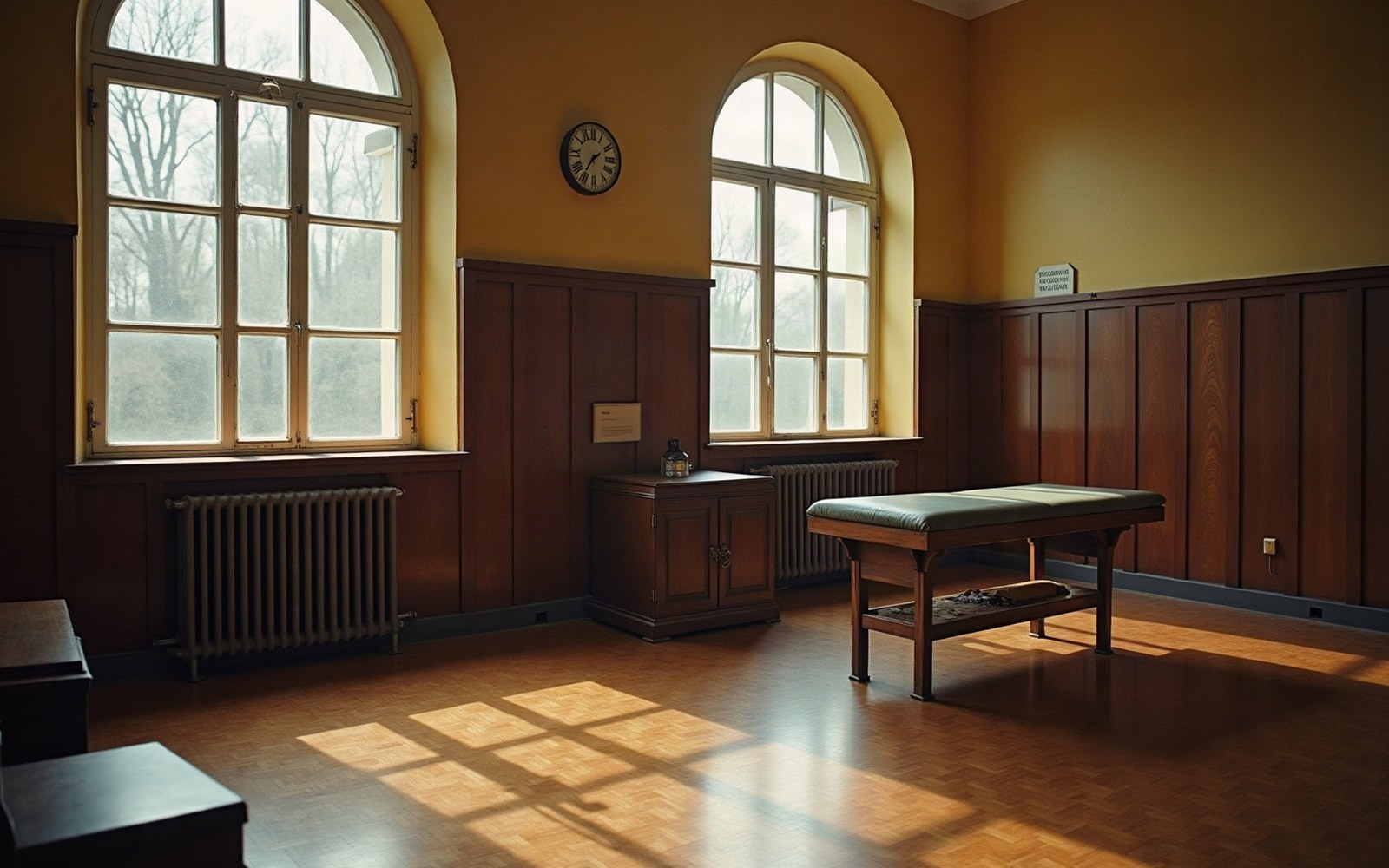
The physiotherapy department of an interwar British general hospital occupied, on average, a converted ward or a purpose-built annex on the ground floor — positioned for the ramp access that wheeled chairs and crutches demanded, and lit, where architects complied, by high windows on the long wall. What the room contained was not neutral. Every piece of apparatus in it represented a professional argument about who did this work and why they deserved a named department in which to do it.

The dominant furniture was the parallel bars: two horizontal rails, adjustable in height, bolted to the gymnasium floor along its central axis. Their placement defined the room's hierarchy — patients moved toward them; everything else arranged itself around that trajectory. Against the walls stood the short-wave diathermy units, cabinet-sized and dial-faced, and the wax bath vessels, heated and lidded, serviced before each session. A goniometer hung near the treatment record desk. The plinth — the padded table at which individual patients were assessed — occupied a corner or an alcove, separated from the exercise floor by screens or simply by convention.
The Chartered Society of Physiotherapy, which had held its royal charter since 1920, understood the gymnasium as evidence: evidence that physiotherapy was a discipline practised in a defined space with documented instruments and a trained staff, not a bedside service delivered by nurses with spare time. The layout encoded that claim. A room with a record desk, calibrated apparatus, and a floor plan organised around therapeutic progression from support to independence was a room that belonged to a profession.

At Oswestry, the hospital Robert Jones and Agnes Hunt had built up from a rural cottage, the gymnasium was integral to the orthopaedic model from early in the century — the ward and the exercise room were conceived as sequential, not parallel, spaces. That sequence, patient to gymnasium to measured discharge, was the physical form of a clinical argument that movement, supervised and recorded, was itself treatment.
By the mid-1930s the argument was winning. Hospital building programmes in Britain and the United States began specifying dedicated gymnasium space in new construction rather than adapting existing rooms. The tilt table appeared in the more generously funded departments. Equipment catalogues grew thick. And the room's scale — typically modest, often shared with occupational therapy — nonetheless carried within its dimensions the insistence that the profession had earned a fixed address inside the institution, not just a borrowed corridor, not just a nurse in better shoes.
Chronology
- 1813Royal Gymnastic Central Institute opens in Stockholm; earliest institutional gymnasium for therapeutic movement
- 1920Chartered Society of Physiotherapy receives its royal charter; professional identity formalised
- 1930sBritish and American hospital building programmes begin specifying dedicated gymnasium space