The licensing of two polio vaccines, six years apart, closed the institutional era that had defined physical therapy's mid-century expansion.
The first vaccine reached the public through an event that was itself a piece of institutional theatre. On 12 April 1955 — the tenth anniversary of Franklin D. Roosevelt's death — Thomas Francis Jr. announced at the University of Michigan that Jonas Salk's inactivated polio vaccine was safe and effective. The announcement followed the largest field trial in American medical history: roughly 1.8 million children, known as Polio Pioneers, had participated in 1954 across forty-four states and two Canadian provinces. The US government licensed the vaccine the same day Francis read his report.
Key dates
- 12 April 1955Salk vaccine announced effective and licensed, University of Michigan
- 1954Salk field trial conducted; approximately 1.8 million child participants across 44 states
- 1957US annual polio cases below 6,000, down from 57,600 peak in 1952
- 1958–1960Sabin oral vaccine mass trials, Soviet Union and Eastern Europe
- 1961Sabin oral vaccine licensed in three separate serotype approvals, United States
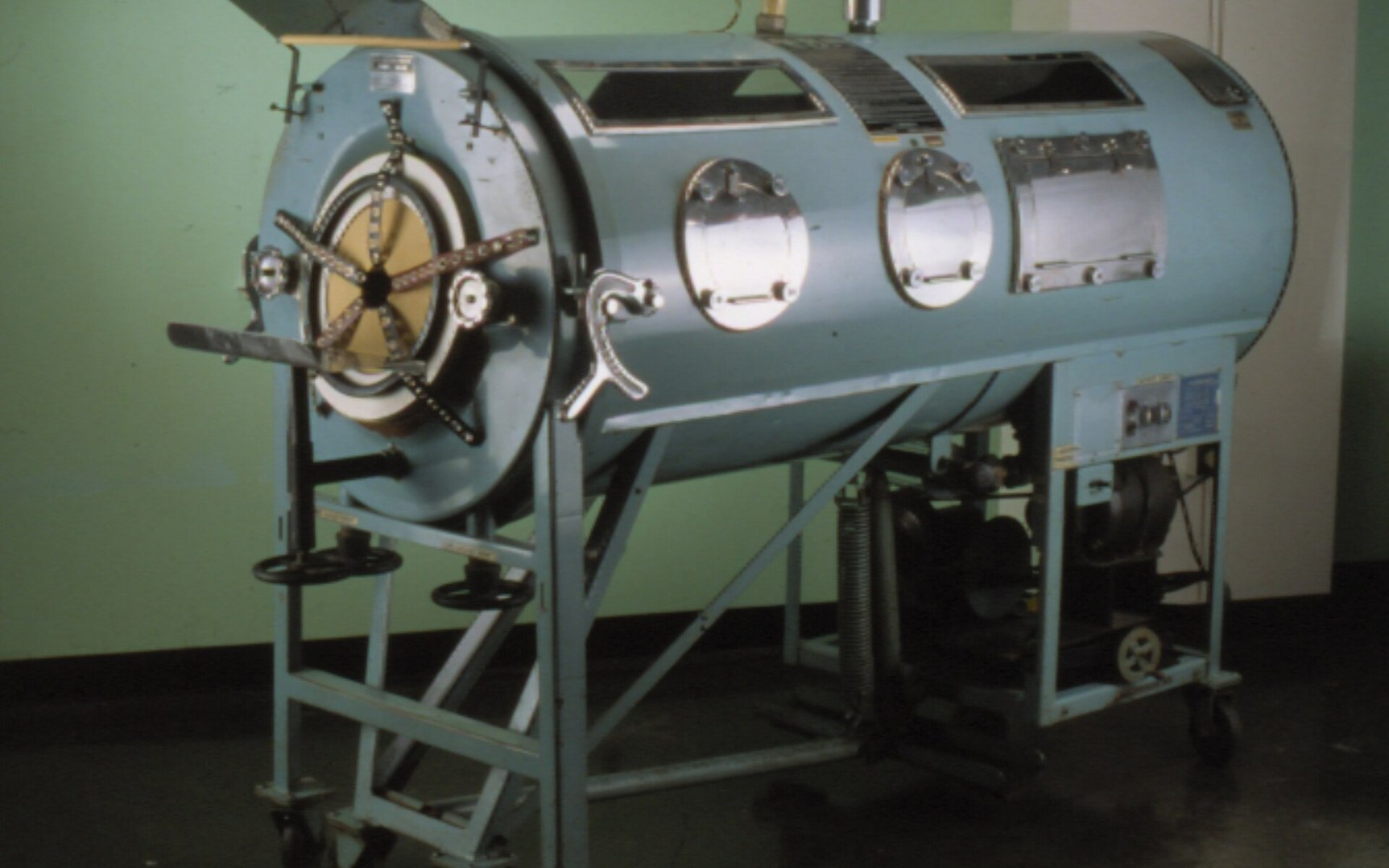
The institutional consequences arrived quickly. The 1952 season had produced more than 57,600 reported American cases — the peak on which the rehabilitation infrastructure had been built. By 1957, two years into the Salk programme, annual cases had fallen to below 6,000. Respiratory wards that had been constructed or expanded at facilities such as Rancho Los Amigos National Rehabilitation Center in Los Angeles County found their iron-lung census contracting faster than any planner had projected. The parallel bars and tilt tables remained; the patients requiring them diminished season by season.
The second event came from Albert Sabin. His oral vaccine, using live attenuated virus, had been tested not primarily in the United States but in the Soviet Union and Eastern Europe, where trials involving tens of millions of subjects were completed between 1958 and 1960. The United States Public Health Service licensed Sabin's oral vaccine in 1961, issuing separate approvals for each of the three serotypes across that year. The oral route — requiring no needle, no clinic appointment, no cold-chain infrastructure at the point of delivery — suited mass immunisation drives in a way the injected Salk preparation did not.
The two programmes were not rivals in the ward sense: by the time Sabin's vaccine entered American use, the Salk campaign had already broken the epidemic curve. What the Sabin programme completed was the institutional exit — the point at which polio ceased to be a planning assumption for hospital administrators and rehabilitation architects. The Warm Springs Foundation, the polio wards of New York City's municipal hospitals, the respiratory unit at Rancho Los Amigos: all continued to treat existing patients well into the 1960s, but no equivalent infrastructure was built to receive new ones.
What the six years between the two licensing dates actually documents is a profession catching up with an emergency that had already begun to recede — closing wards faster than it had opened them.